



This article was originally published in the July/August 2026 issue of The New Brewer under the title “Understanding Gen Z”
By Mike Kallenberger
The earliest-arriving members of Generation Z crossed the threshold into legal drinking age about seven years ago. For those who have an interest in gaining insights into this cohort’s attitudes, values, and behavior—including almost anyone in the alcohol beverage business—the learning curve has been steep, but we’ve been mounting it reasonably rapidly.
It’s clear that many members of Gen Z (born between 1997 and 2012) have a different relationship with alcohol beverages than previous waves of “entry level” drinkers. Beer, distilled spirits, and wine have all felt the impact in softer sales and in other ways. And a consensus has emerged on at least some of the causes: many Gen Zers are short on spending money; a significant portion of them not only have an interest in wellness but are acting on it; they seem to socialize less frequently than earlier young adult generations; and their alcohol occasions have veered from traditional drinks toward flavored beverages, including RTD cocktails.
But craft beer has been hit particularly hard, and the above list offers only limited insight into reasons for any disproportionate impact. The craft category may in fact be suffering in part due to a misalignment, not just with Gen Z’s habits and taste preferences, but between this generation’s more abstract attitudes and values and traditional craft culture.
In a previous article for The New Brewer, “Craft Brewing and the Evolution of American Culture” (March/April 2018), I argued that American culture had been influenced by a Millennial generation (born between 1981 and 1996) that saw many of their own values reflected in craft beer. The same may not be true of Gen Z’s emerging influence. In particular, Gen Zers are less likely to share the optimism and belief in personal agency that helped define young Millennials. An early harbinger of this transition: the rise and fall of Harry Potter.
The Harry Potter Effect

Trends in popular entertainment can often provide clues as to the attitudes, values, and motivations of a new young-adult generation beginning to assert its influence. When Millennials were growing up, there was no child character more prominent than Harry Potter. It’s not an exaggeration to say that the Harry Potter books and movies captured the zeitgeist of Millennials’ formative years.
Those books and movies consistently tapped into narrative themes such as heroism, personal agency, and personal growth. These themes resonated with the aspirations (if not the reality) of young Millennials. It’s no coincidence that members of a generation who found a role model in a fictional heroic wizard also embraced craft beer culture, itself a repository of similar values. My earlier article cited themes in craft culture such as self-expression through work and creative rebellion, which are variations to one extent or another on Millennial aspirations such as personal agency and growth.
To further illustrate how these trends in the entertainment industry can mirror what’s going on in categories like beer, it’s worth comparing the Harry Potter narrative with the thematic landscape of an earlier Gen X-oriented child character. Bart Simpson was in many ways the antithesis of Harry Potter: a wisecracking, “proud underachiever” who only wanted to have fun. And while 1990s-era Gen Xers (born between 1965 and 1980) were helping elevate The Simpsons to its peak of popularity, they were embracing similar values and motivations in their choice of beers.
Bud Light was the beer category’s growth story of that decade, and it thrived by presenting a brand personality that arguably had a lot in common with Bart Simpson. Long-term ad campaigns for the then-leading light beer celebrated willfully mindless fun (think Spuds MacKenzie) or unambitious but clever people taking shortcuts to scam their way to a free beer (such as the phony Dr. Galazkiewicz).
So, yes, it really may not be much of a stretch to say the fate of craft beer culture is intertwined with the rise and fall of Harry Potter. This is why a recent New York Times opinion piece about how and why the wizardly entertainment franchise has failed to resonate with many Gen Zers might give us pause, and even force us to rethink how craft beer culture may have to evolve as a result.
Two Different Worldviews
In her op-ed for The New York Times in January, journalist Louise Perry described how “the relevance of the [Harry Potter] franchise is waning.” She points out that the majority of the movie-going audiences for a 2016 launch of a spin-off series were over age 25 (i.e., mostly Millennials) while just 18% were children (in other words, Gen Zers or younger). Gen Z comedians and online influencers have been known to make fun of 30-something Millennials for their persistent love of Harry Potter.
Perry goes on to find that the reason for the disconnect between the two generations’ attitudes about Harry Potter has its roots in their differing attitudes about life in general, which are in turn a product of how they experienced the world during their formative years. While Millennials’ worldview was forged during relatively optimistic times, Gen Z “came of age after the global financial crisis of 2008 and has since witnessed long periods of stagnant wages and declining state stability… They are a generation that has barely known an optimistic period of politics…a generation more likely than their predecessors to view their lives as controlled by external forces, rather than their own choices and will.”
This latter point may be one of the key distinctions between Millennials and Gen Zers in terms of the latter group’s relative inability to relate to both Harry Potter and traditional craft beer culture. What Perry is describing here is what psychologists term an external locus of control. The presumption would be that young adult Millennials, in contrast, were more likely to have an internal locus of control—a belief that one’s own actions and decisions are the primary determinants of how your life unfolds. This is a more academic way to describe the sense of personal agency that characterizes aficionados of both Harry Potter (as teens) and craft beer (as adults)—they believe they can make a difference, and they relate to narratives that share that belief. In contrast, it’s a lot tougher to relate to values like self-expression through work or creative rebellion when you’re doubtful that your own choices can have an impact.
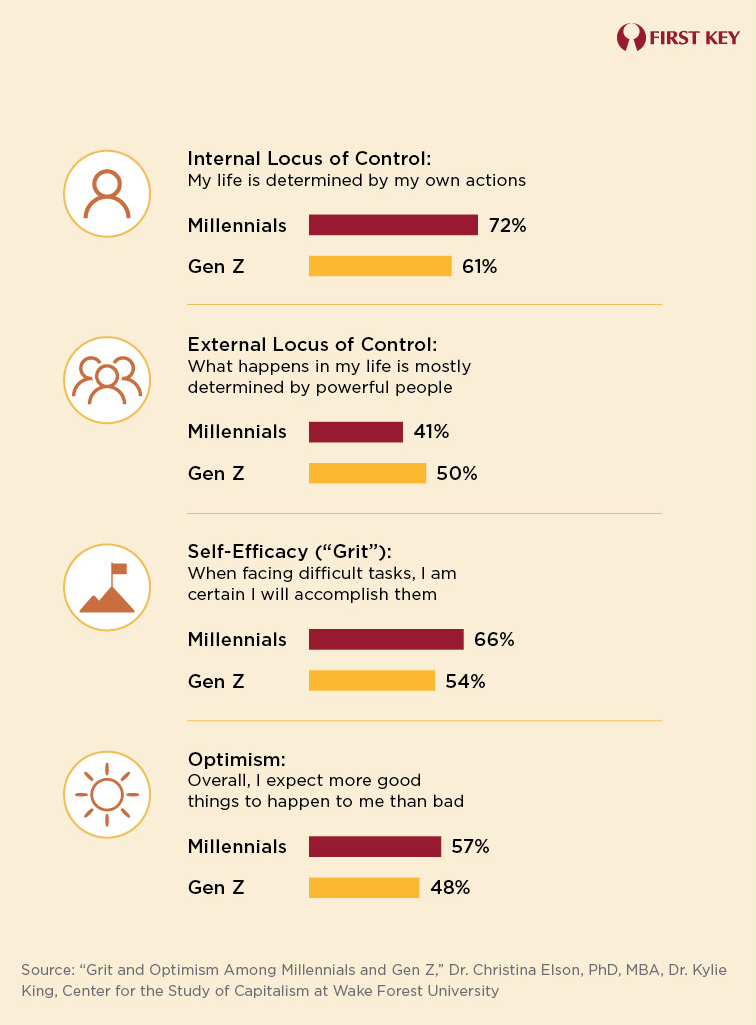
And in fact, these differences in the views of Millennials and Gen Zers about their ability to control their own lives is not just a presumption. It’s been backed up by studies such as Grit and Optimism Among Millennials and Gen Z, by Christina Elson and Kylie King at Wake Forest University (cited in passing by Perry). The authors address their title bluntly when they state, “Millennials are grittier and more optimistic than Gen Z,” defining grit as “the ability to recover from failure and persevere in the face of challenges.” They also found that “[Gen Zers] demonstrate a weaker internal locus of control and lower self-efficacy, meaning they don’t feel confident their behavior will shape the direction of their life and the world around them.” (See Figure 1.)
Figure 1:
Key Attitudes and Values of Millennials and Gen Z
Cultural Trends
My earlier article described three U.S. cultural trends as key enablers of craft beer culture’s rise: openness to new experiences, self-expression through work, and creative rebellion. All three relate to values of personal agency and growth. But if these values have declined, what might be replacing them as aspirations among Gen Z? Comfort, contentment, and fun will likely be a big part of the answer.
Let’s check in on the status of each cultural trend and the implications for how craft beer culture may evolve.
Openness to New Experiences
New experiences are often a platform for personal growth. Gen Z can be very open to some types of new experiences, but it doesn’t appear that seeking variety in their beer drinking is one of them. Many craft brewers took advantage of earlier generations’ openness by stretching the boundaries of how beer was understood by drinkers, whether through style-based education, higher ABVs, increasingly intense flavors, and innovations like barrel-aging. This joy in variety-seeking, while not shared by all craft drinkers, nonetheless became a hallmark of craft beer culture.
But comfort-seeking Gen Zers have been far more likely to embrace predictability rather than broaden their horizons through new-to-them beer styles. Of course, many craft brewers have already caught on to this, offering a lineup of familiar IPAs and eschewing boundary-pushing innovation in favor of craft lagers, Pilsners, and other seemingly “safe” choices.
This doesn’t necessarily mean experimentation should fall by the wayside, but it will require that less familiar styles be presented with comfortable cues. One such cue might be nostalgia; the 1990s are big among Gen Zers, who see it as a simpler time. (This may explain all those Nirvana T-shirts we’ve been seeing on 20-somethings.)
Gen Z’s comfort-seeking might also be a consideration in taproom and brewpub design. Is the industrial chic style of so many places in fact a better fit with a former era’s openness? We don’t know the answer to that. But it might be fair to speculate that even something as simple as installing warmer lighting or replacing benches with couches would enhance a brewery’s (and a brand’s) association with comfort.
Self-Expression Through Work
Young adult Millennials certainly sought careers that paid well, but they also wanted their work to reflect their own values, not just a way to fulfill the demands of the market. In this, they related to the narrative that craft brewers had themselves essentially rejected the mainstream in favor of celebrating more interesting, if not top-selling, styles.
But labor market conditions over the past two decades have changed work-related aspirations markedly. As Elson and King point out, “many [Gen Zers] are concerned about being left behind economically. They choose practical careers and assume they will have to work hard to achieve financial goals while, at the same time, feeling less optimistic about their ability to achieve good outcomes.” It’s unlikely that opportunities for self-expression through work are a high priority for someone concerned about finding steady, reasonably good-paying work, period—arguably another way in which they prioritize comfort over growth.
How might craft culture, or at least individual craft brewers, reframe the narrative to be more relevant in the Gen Z era? One approach might be found in the evolution of the third cultural enabler.

Creative Rebellion
Creative rebellion was an important value for young Millennials. Unlike the traditional rebellion embraced by previous young adult generations (exemplified by iconic figures such as James Dean, Easy Rider, or Tupac), Millennial rebellion was directed less against authority and more against conformity. Craft beer culture has historically celebrated creativity and creative rebellion.
But, like self-expression through work, creative rebellion appears to be less relevant to a generation that feels disempowered. Gen Z does have a rebellious streak, though the target of their rebellion is typically not conformity, but injustice. Hypothetically, this aversion to injustice may or may not be rooted in their own feelings of having gotten a bad deal simply because of the era in which they were born. But they take action on behalf of others seen as being treated unfairly. A majority of Gen Zers say they’ve attended a protest or volunteered for causes that are meaningful to them.
And according to survey research firm Kantar, 57% of adult Gen Zers say they make an effort to buy products that support causes they care about; 79% agree that companies that make sincere efforts to invest in their community deserve their loyalty. Whether or not the entirety of craft beer culture could or should align itself with a specific cause, individual breweries (many of whom support such causes already) would likely be well-served by making those causes more central to their identity.
An Evolving Landscape
Are comfort, contentment, and fun some sort of new “big three” values for craft beer culture to embrace? That would be oversimplifying. At minimum, brewers intrigued by a potential move in this direction must be cognizant of how it would work in terms of their own established brand identity. If there’s a Gen Z archetype as significant as Bart Simpson or Harry Potter were to previous generations, they haven’t emerged yet. But for brands navigating the evolving landscape of consumer attitudes and values, “a little less Harry Potter” wouldn’t be a bad rule of thumb.
Mike Kallenberger is senior advisor, marketing insights and strategy at First Key (firstkey.com), a brewery consulting firm. He is a longtime contributor to The New Brewer.


 Resource Hub