

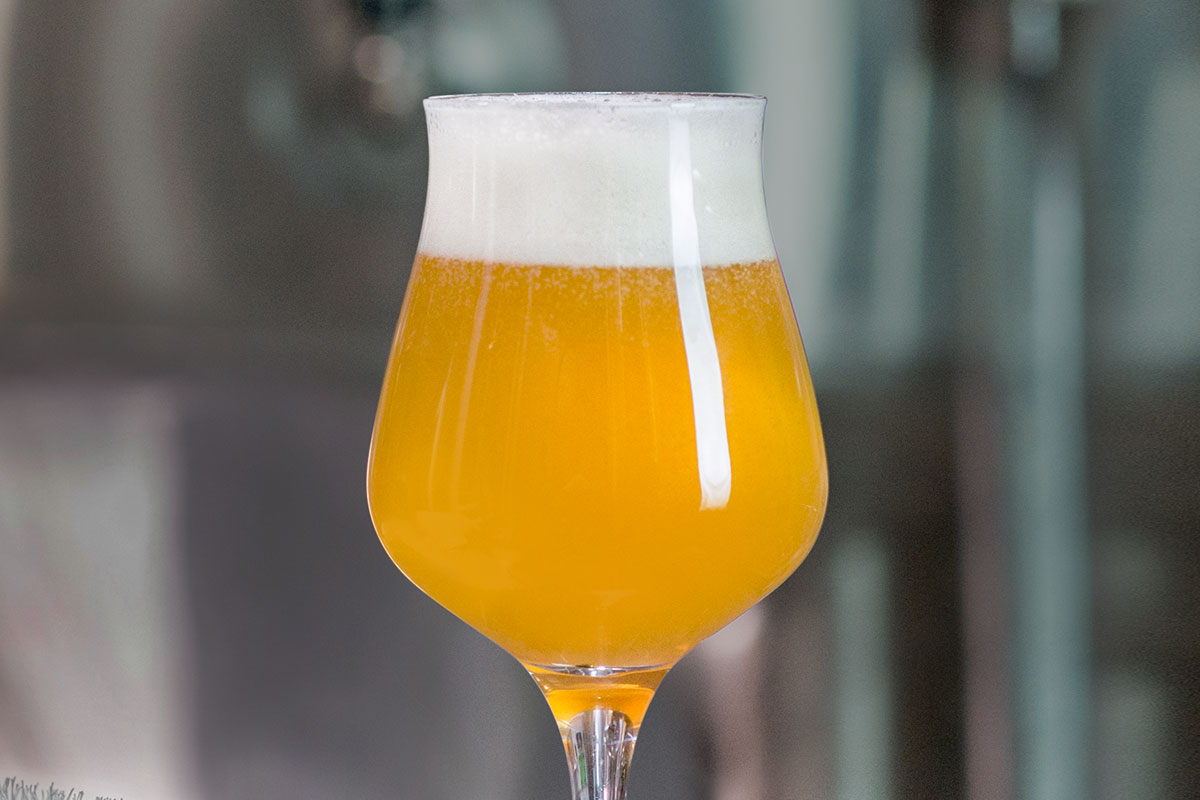

When it comes to the enigmatic style of saison, balance is key.
“All the flavors and aromas should be in balance, perfectly integrated,” says Yvan De Baets, co-owner and brewmaster of Brasserie de la Senne in Brussels, Belgium. “It should be extremely drinkable, simple and complex at the same time.”
Saison, or “season” in French, originated in the French-speaking region of Belgium known as Wallonia, brewed during the late fall to early spring as provisions for migrant workers (“saisonniers”). These farmhouse ales were made during the “good” brewing season (winter) and normally consumed during the “bad” brewing season (summer), according to De Baets.
The flavors and aromas of saison include a “noticeable vinous Brettanomyces character, in balance with noble hop and malt flavor; a pleasant lactic tartness that enhances its refreshing character; and a dry finish but with adequate mouthfeel,” said De Baets.
Brewers have many options to build in layers of complexity.
“Things like using a Pilsner malt from a craft maltster or using spelt instead of wheat—these minor changes will add up and help make a saison more interesting,” said Will Quinlin, co-founder of The Big Friendly in Oklahoma City. “Specialty grains and Brett are part of those layers.”
The Big Friendly won gold medals in both Saison categories (Classic and Specialty) at the 2025 Great American Beer Festival. “Winning gold for these beers was a really cool experience,” said Quinlin. “The Classic Saison category medal is the one I’m most proud of since it’s where I started my journey with the farmhouse style.” He’s been brewing the style for around 15 years, becoming interested while living in San Diego.
“I’d grab any Belgian bottle I could find,” he said. “It was fun to explore all the styles.”
The Big Friendly’s Universal Beings, which took gold in the Classic Saison category, is brewed with Pilsner and wheat malts and hopped early in the boil with German noble hops including Hallertau Mittelfruh. Goodbye Bread, which claimed gold in the Specialty Saison category, is a kvass-inspired farmhouse ale made with Pilsner malt and homemade sourdough bread.
De Baets mentioned in his seminar at the Craft Brewers Conference in April that his favorite specialty grain for saison is spelt.
“I like the fresh cereal character it imparts,” he explained. “It also gives a nice body and great foam.”
When it comes to yeast, De Baets mentioned that many primary yeasts—including saison-specific yeast—can be used for the style, with the secondary fermentation being the most important. “If there has been one ‘saison’ yeast, it is Brettanomyces.”

But De Baets, who has been studying and brewing the style for more than two decades, believes using POF+ (phenolic off flavor positive) yeast is not mandatory. “If a POF+ yeast is used, the phenolic character should stay in balance and not overwhelm everything.”
Quinlin said he experiments with different saison strains, both single and blended. “We have three stainless tanks that are only for saison,” he said. “I’ll start out with one yeast strain in each tank and then I’ll mix yeast between them to see what happens.”
De Baets, who judged the category at the 2026 World Beer Cup, said he sees many common mistakes when brewing the style.
“The main one is that many of them are phenolic bombs, where medicinal phenols completely overwhelm the beer. It creates beers that are totally unbalanced—no room for grains, hops, and other fermentation flavors—with poor drinkability. Some are huge in fruity esters, one-dimensional, and resemble more a Belgian blond. Some are not well-attenuated and impart a remaining sweetness. Some are overly spiced. And a lot of them are obviously too strong. If you can taste the alcohol, there is an issue.”
Key characteristics
- Well attenuated
- Complex
- Balanced
- Drinkable
- Dry finish
- Brettanomyces (in traditional versions)
More information: BA Style Guidelines




 Resource Hub