



This article was originally published in the July/August 2026 issue of The New Brewer.
By Richard Preiss
As brewers, we spend a lot of energy on our recipe and process design. Many of us take a week out of our year to go to hop selection so we get exactly the right hops for our IPA. We obsess over grain bills, making sure we use the perfect Pilsner malt. But when it comes to yeast nutrition, a lot of folks just throw a generic scoop into the kettle and call it good.
In some ways, that approach is reasonable. However, most yeast nutrients themselves are generic, often designed for distillation or winery applications. Also, you’ve probably heard a brewer on a podcast talk about soluble zinc, or warn you about the risks of excess FAN (free amino nitrogen). All of this makes yeast nutrition a confusing topic.
Luckily, we can treat yeast nutrition through the lens of the Pareto Principle: this 80/20 rule states that 80% of outcomes often come from 20% of related inputs. In brewing fermentation, FAN and zinc are the 20% of your nutritional inputs that drive 80% of your fermentation and yeast health results. In this article, we’ll break down exactly how to manage them, why modern brewing trends like heavy dry hopping change the rules, and how missing the mark can ruin your beer with off-flavors. The goal is to help you demystify yeast nutrition so that you can get more efficient ferments in your cellar and stretch the value of your yeast through more generations.
The FAN Goldilocks Zone and Hidden Sources
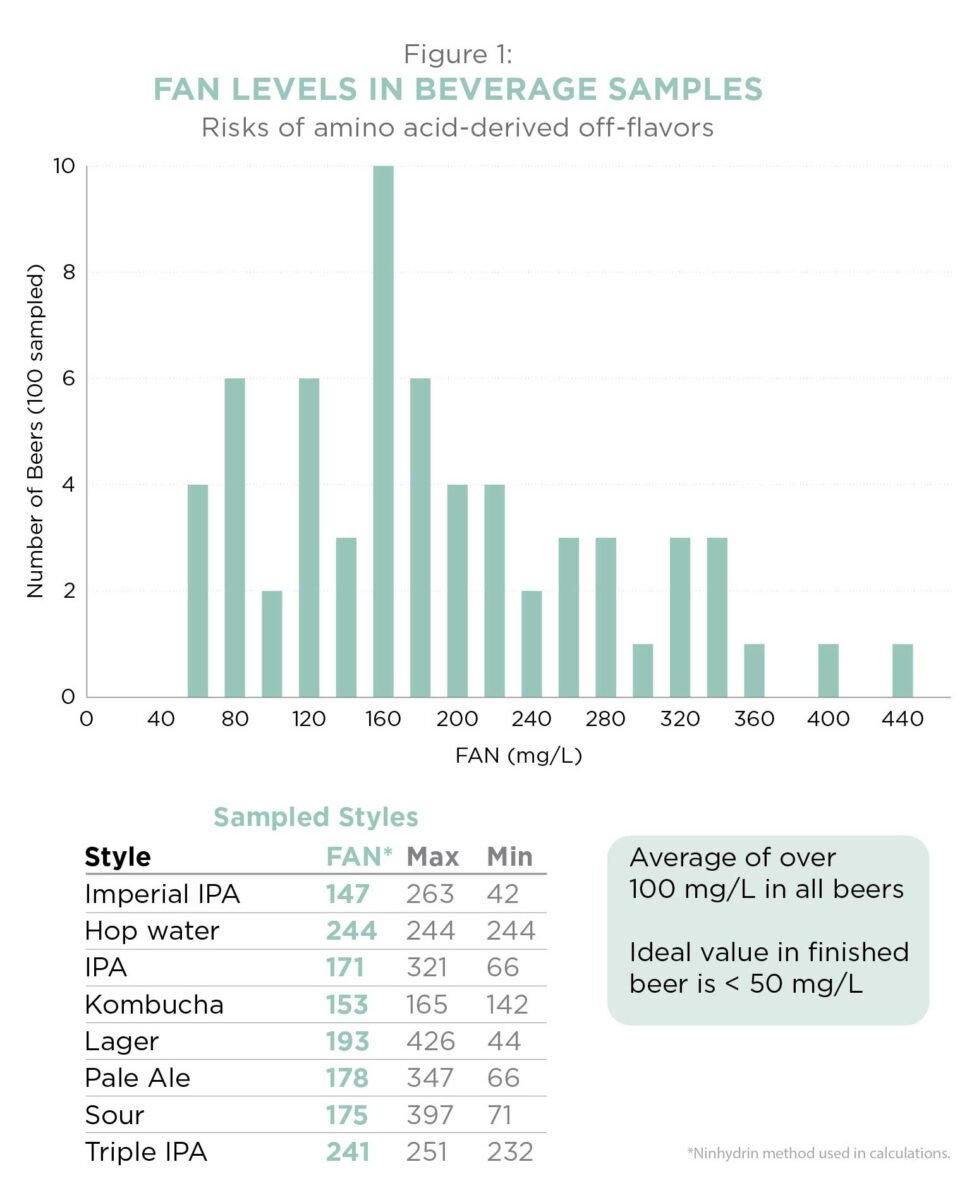
Let’s start with FAN. For decades, the industry standard has focused heavily on making sure we have enough free amino nitrogen in the wort to prevent yeast stress, especially in adjunct-heavy macro beers. But in modern craft brewing, we are seeing a different issue: the consequences of excess residual FAN. In general, the target for beer stability is to have less than 50 ppm residual FAN. This is what most large breweries aim for.
UC Davis’ Dr. Glen Fox tested more than 100 commercial craft beers, and the results were eye-opening. (See Figure 1.) The average across all styles was over 100 mg/L of residual FAN in the finished product. Double IPAs, IPAs, and even standard lagers frequently peaked well above 250 to 400 mg/L.
Why do we care about excess FAN? Because amino acids left behind are fuel for spoilage organisms, and worse, can serve as direct chemical precursors to oxidation-related off-flavors. Through pathways like Strecker degradation, amino acids break down into staling aldehydes. For instance:
- Excess proline and lysine degrade into compounds that cause a mousy, breadlike off-flavor.
- Leucine transforms into 3-methylbutanal, throwing a cocoa/almond stale note.
- Methionine can impart dimethyl trisulfide, which smells exactly like cooked onions or skunk.
- Unassimilated proline bonds directly with polyphenols to form permanent, unwanted hazes.
Where is all this extra FAN coming from? It’s not just modern malts. Another culprit in modern brewing is hops. When you massively dry hop a beer, hops can add significant amounts of amino acids to the cold side. Specifically, hops introduce massive loads of asparagine and arginine relative to your malt.
Furthermore, your process drastically changes how yeast consumes this nitrogen. For example, our data shows that multi-fill, multi-day tank filling practices reduce your mean FAN utilization compared to single-fill batches, leaving high amounts of residual FAN behind.
Mind the Zinc Gap
Now let’s talk about the single most common micronutrient deficiency in brewing: zinc.
Zinc is a critical cofactor for more than 300 enzymes in the yeast cell, most notably alcohol dehydrogenase (ADH1). ADH1 is the zinc metalloenzyme responsible for turning acetaldehyde into ethanol and helping clean up diacetyl (VDK reduction). If your yeast lacks zinc, it cannot handle metabolic stress, it struggles during the stationary phase and storage, and its viability plummets, making it unsuitable for repitching.
So why is zinc usually low? Because of the malting process. Barley naturally contains zinc, but during germination, almost all the bioavailable zinc moves into the roots (rootlets) of the seed. When the malthouse cleans the malt, those rootlets are broken off and discarded. You are left with a malt loss that strips away almost 90% of the grain’s initial zinc.
This zinc gap becomes critical in heavily dry-hopped beers due to hop creep. When hop enzymes release new fermentable sugars on the cold side, the yeast needs to reactivate its metabolism to ferment them. If the yeast is starved of zinc, it cannot efficiently operate, which can lead to incomplete fermentations or high residual diacetyl.
How do you fix this? You have to add it back, but how and when matters. There are several options, including:
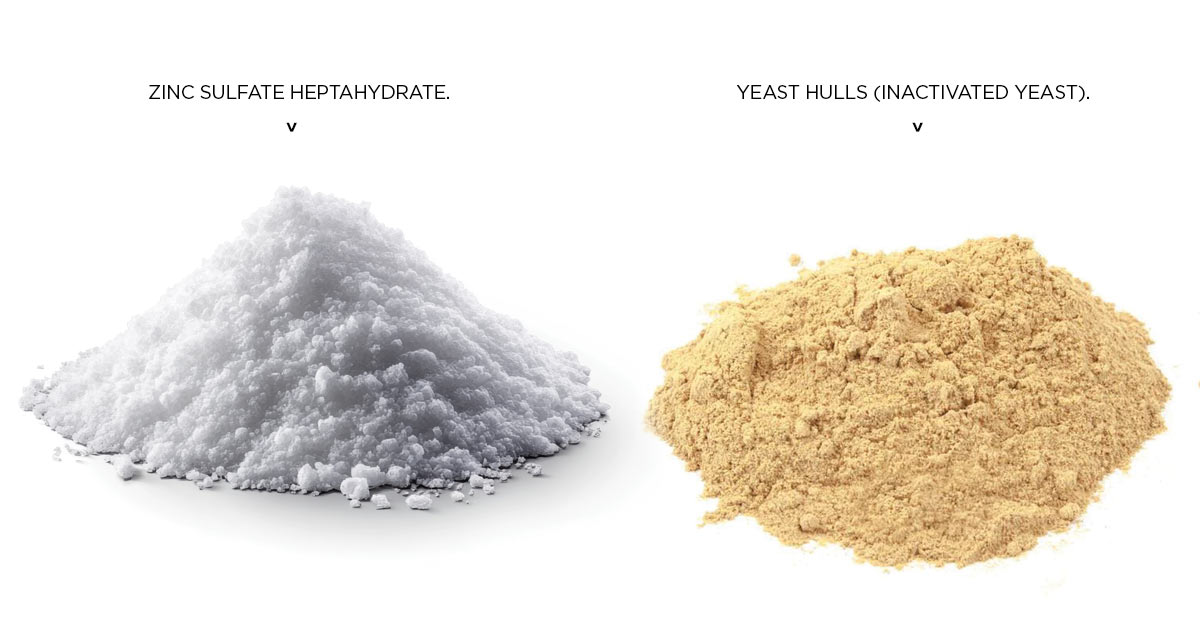
- Zinc sulfate heptahydrate: Precise and easy to dose as a sterile solution.
- Bio-bound zinc: Yeast hulls (inactivated yeast) packed with organically bound zinc that offer clean, assimilation-ready nutrition.
- Complex nutrient blends: Provide an insurance policy by adding zinc alongside other necessary vitamins and minerals.
If you add zinc to the hot side (kettle), it ensures excellent mixing, but you will lose a portion of it because zinc binds to proteinssoluble zinc directly to the cold side (fermenter), you maximize availability, but your sanitation and dosing calculations must be dialed in. In general, you want to target a fermenter zinc specification of 0.2 to 0.3 ppm.
Beyond the 80/20 Ryle: Magnesium and B Vitamins
What happens if you’re adding zinc, your FAN looks fine, but you’re still getting sluggish fermentations, diacetyl issues, or excessive sulfur production? This is where we look at the minor players that can make a major impact: magnesium and B vitamins.
Magnesium drives cell growth and yields faster, more complete fermentations while pushing your aroma profile toward pleasant esters and away from hot fusel alcohols.
The trick here is the magnesium-to-calcium ratio. In modern hazy IPAs, brewers often hammer the water profile with massive amounts of calcium chloride to get that soft mouthfeel. But if calcium levels are increased significantly over magnesium, it causes a competitive inhibition effect. The root cause of many stalled ferments, long lag phases, diacetyl spikes, and extended hop creep in juicy IPAs can be calcium blocking magnesium uptake. Adding magnesium sulfate (Epsom salt) improves fermentation kinetics in these high-calcium environments, particularly in hazy IPAs.
Finally, consider vitamins. Yeast vitamin needs are highly strain dependent. Some English strains as well as traditional lager strains are heavily reliant on biotin (Vitamin B7) and thiamine (Vitamin B1). High biotransformation strains often have a requirement for pantothenate (Vitamin B5). Have you ever had a beer with a perfectly healthy FAN level that still reeks of heavy, rotten-egg hydrogen sulfide? That is a classic symptom of a pantothenic acid deficiency. Without it, the metabolic pathway that builds sulfur-containing amino acids cannot function, and the yeast spits out pure hydrogen sulfide gas.
Because vitamin levels vary wildly across crop years and are absent from your malt Certificate of Analysis (COA), utilizing a complex nutrient blend can help ensure your yeast has the tools it needs. In our trials with a lager strain across 28 craft breweries, using a complete nutrient containing zinc and B vitamins brought beers to final gravity an average of two days faster and vastly improved yeast storage viability over a four-week period.
Action Items
So, what should you do in your brewery today?
- Start integrating a complex nutrient blend into your process to establish an insurance policy for the baseline of yeast nutrition.
- Spend a little cash on a wort analysis to measure your actual wort zinc level across three baseline batches. If you use a third-party lab for water analysis, they should be able to test your wort.
- Calculate your average zinc yield and adjust with precise, sterile soluble zinc sulfate in the fermenter if you aren’t hitting the target of 0.2 to 0.3 ppm.
Dial in your nutrition and your yeast will reward you with flavor stability and predictable repitching.
Richard Preiss is co-founder and CEO of Escarpment Laboratories in Guelph, Ontario, Canada.


 Resource Hub