

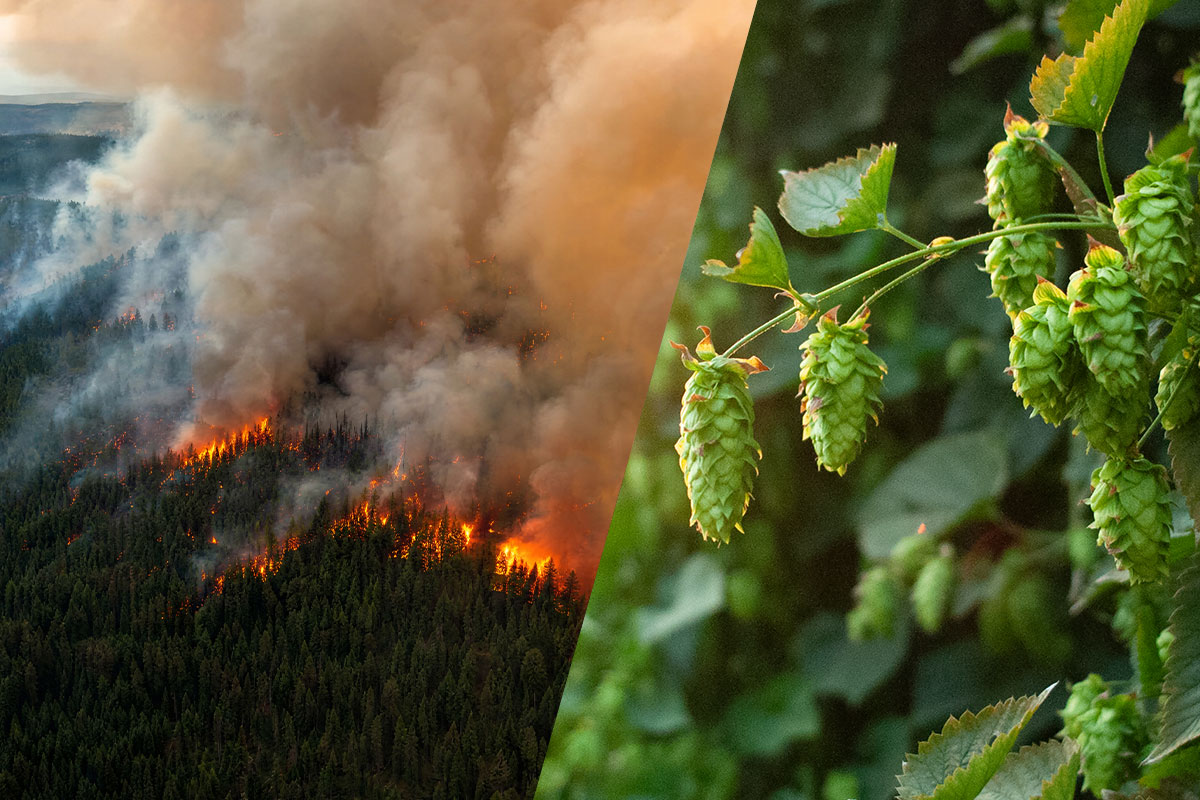

Continued drought and wildfires in the Pacific Northwest and British Columbia have raised concerns about the potential effect of smoke taint on the 2026 hop crop. With two months left in the fire season, this year’s fires could rival the catastrophic 2020 season.
Foundational Research on Smoke Taint in Hops
Although the effects of wildfire smoke on grapes has been well documented, the effect of smoke taint in hops and finished beer didn’t gain much attention until a massive windstorm over Labor Day in 2020 ignited thousands of acres, covering the area in thick smoke during the peak of harvest.
After the 2020 harvest, a study published in the Journal of the American Society of Brewing Chemists identified the chemical profile of smoke tainted hops, creating a foundation for additional research. A 2026 study from Oregon State University has shown hops exposed to simulated wildfire smoke during kilning have increased levels of volatile phenols, notably Guaiacol and 4-methylguaiacol, which are perceived as smoky and meaty flavors and aromas. The study also showed that as volatile phenols in the hops increased, citrus and overall hop aroma declined.
Kilning hops involves relatively high volumes of airflow. If wildfire smoke is present during kilning, the hops are exposed to similar air quality and environmental conditions. Logically, if volatile phenols are present in the air, the hops will also be exposed to them. However, while the Air Quality Index (AQI) can be a good indicator of smoke taint potential, it doesn’t measure the smoke’s chemical composition and can be misleading. Finally, the impact of smoke during cone set, maturity, and harvest is less understood. More research is required to better understand the relationship between smoke and hops in the field.
Identifying Smoke Tainted Hops
Earlier this year, the American Society of Brewing Chemists published Sensory Analysis Method 20, Hop Sensory Evaluation Method for Detection of Smoke Taint. This new method provides a simple sensory approach to detecting smoke taint when sourcing whole leaf hops and hop pellets. The method is for evaluation of hops for smoke taint, and not an indication of flavor carryover to beer.
Mitigating the Effect of Smoke Taint in the Brewery
The Brewers Association published a brief on Hop Smoke Taint as part of the Off Flavor Management series. This paper identified proactive measures brewers could use to control hop smoke taint in the brewery. The brief notes that some brewers have observed that using smoke-affected hops during boiling for bittering additions did not result in noticeable smoky characteristics in the final beer. The opposite was true for dry hopping with the same hops. Clearly more research needs to be conducted examining flavor and aroma carryover of smoke taint characteristics in hops to beer.
The Current Outlook
The hop growing regions in the Pacific Northwest can reasonably expect variability in air quality during the harvest season due to changing weather patterns and likely continued drought. Atmospheric conditions can, and have been, changing daily, even at the farm level. The general consensus is that it is too early to make a prediction related to harvest quality. Brewers who are concerned about smoke conditions are encouraged to reach out to their suppliers directly to learn about their protocols and contingency plans. Growers and merchants will continue to monitor the situation and make adjustments, if necessary, to picking and kilning schedules to ensure the quality of the harvest and the safety of their workers.
Further reading:
- Characterization of Smoke Taint in Hops: Insights from Laboratory Simulation and Chemical Profiling
- Kilning With Smoke-Affected Air Impacts the Chemical and Aromatic Qualities of Cascade Hops


 Resource Hub