



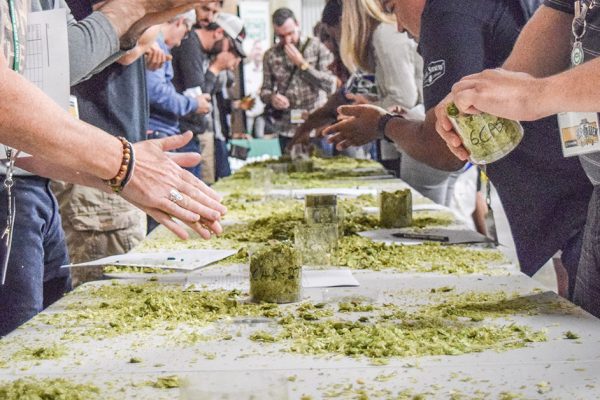
Brewers Association staff held the 10th annual Hopsource public hop sensory evaluation in Yakima, Washington, Sept. 22-24, 2026. For the second year in a row, participants completed more than 1,000 evaluations of 30 experimental hops from the public breeding stations in Prosser, Washington, and Corvallis, Oregon. Hopsource bridges the gap between brewers and breeders to enrich public hop breeding research and introduce new varieties that resonate with brewers and consumers.
Potential New Varieties
Of the 30 hops evaluated, more than a dozen were new crosses created in 2022 or 2023, and 2026 marked their first Hopsource evaluation. Several earned extremely high net liking scores, signaling strong potential for commercialization.
Sharing Information
Brewers are the primary participants in Hopsource, but the event is open to all industry members. Hop growers, merchants, researchers, and allied trade members lend their expertise to the evaluations. Hopsource also serves as a forum for industry members to network and share information, especially about the public hop breeding program. For example, recent Michael James Jackson Foundation scholarship recipients took part in this year’s evaluations and learned how the public hop breeding program benefits the entire industry.
Average Yields, Average Quality
High temperatures, wildfires, water availability, and untimely late rains challenged growers this season, but the 2026 crop looks on track for average yields and average quality. That result reflects how well growers are managing climate challenges, plus some luck in avoiding smoky conditions during harvest and kilning, when hops appear most susceptible to smoke taint.
Hop Stocks Continue To Contract
The 2026 United States Department of Agriculture (USDA) National Agricultural Statistics Service (NASS) September Hop Stocks Report (pre-harvest) put inventory held by growers, dealers, and brewers at 105 million pounds, down 9% from a year ago. The decline reflects ongoing cuts to hop acreage after inventories hit record highs in 2022. As inventories shrink, growers and merchants encourage brewers to keep contracting for future needs so the industry can supply the quantity and variety of hops brewers require.
 Resource Hub